
Resources
This page provides a compilation of resources on varied topics relevant to adult educators. Although the number of research studies focusing on adult learners is limited, the items listed in the "Research" category are evidence-based or recognized as "promising practices" by federal and state agencies.
FEATURED RESOURCE
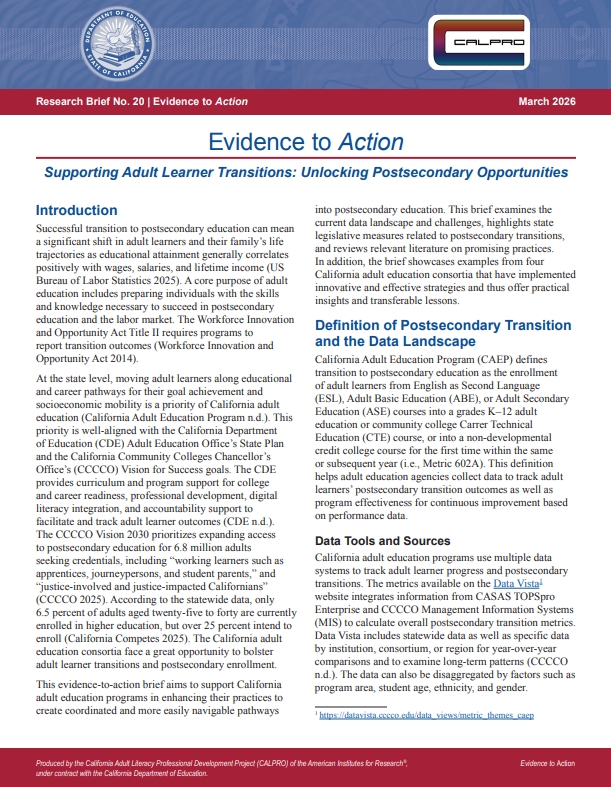
Evidence to Action Brief: Supporting Adult Learner Transitions: Unlocking Postsecondary Opportunities
Successful postsecondary transitions can change the life trajectories of adult learners and their families. Providing effective support for adult learnersâ transition to postsecondary education has become one of the critical missions for adult education. This evidence-to-action brief is designed to help California adult education programs strengthen their approaches to building coordinated pathways into posts ...
MARCH 17, 2026
Resource type: Research Publications
AUDIENCE: Administrators , All teacher types , Support Staff
Topic: Post-Secondary Alignment and PathwaysÂ
File Type: PDF
Serving Internationally Trained Professionals in IELCE Activities
The Enhancing Access for Refugees and New Americans project aims to support adult educators in developing and delivering high-quality IELCE/IET programming in alignment with an immigrant integration approach. Enhancing Access Spotlights describe and provide examples of specific aspects of IELCE/IET implementation. This Spotlight provides an overview of serving internationally trained professionals in IELCE activities.
Serving Refugees in IELCE Activities
The Enhancing Access for Refugees and New Americans project aims to support adult educators in developing and delivering high-quality IELCE/IET programming in alignment with an immigrant integration approach. Enhancing Access Spotlights describe and provide examples of specific aspects of IELCE/IET implementation. This Spotlight provides an overview of serving refugees in IELCE activities.
Career Technical Education (CTE) Model Curriculum Standards - 2013
The Career Technical Education (CTE) Model Curriculum Standards are designed to assist California districts and schools in developing high-quality curriculum and instruction to help ensure that students are career and college ready and to prepare them for future careers. The model standards were created with assistance from more than 300 representatives from business, industry, postsecondary, and secondary education and were reviewed by approximately 1,000 individuals, including members of the general public. The standards are rigorous, evidence-based, relevant, and reasonable in scope. They offer clear guidelines for course content development and expectations for student achievement.
Sample Integrated Syllabus
From the ADVANCE IET initiative, this sample syllabus provides a model example of how to structure and communicate details to learners about the aims, expectations, and core skills components (industry specific, academic, and workplace skills) to be developed within a potential patient care technician course.
Developing an IET Syllabus: Key Elements
From the ADVANCE IET initiative, this checklist is designed to support IET providers in developing a comprehensive, integrated syllabus that can serve as a roadmap for their IET students.
Planning for Student Success: Barrier Busters and Support Strengtheners
This worksheet is designed to support students in Integrated Education and Training (IET) programs, but it is also suitable for use with all adult education learners during orientation. It helps students identify potential obstacles to educational success and document both personal support systems and wraparound services available through the program or its partners.
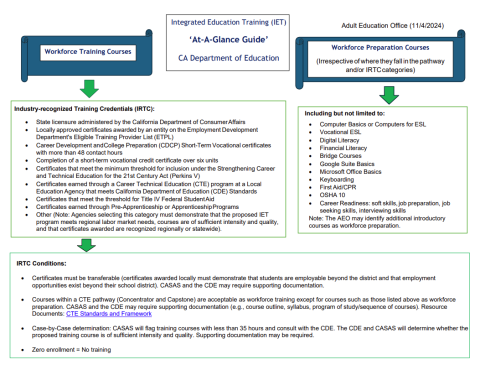
Integrated Education Training (IET) âAt-A-Glance Guideâ CA Department of Education
The âIET AtâaâGlance Guideâ provides a clear, streamlined overview of how agencies should classify and document Workforce Preparation and Workforce Training within Integrated Education and Training (IET) programs. It outlines which courses qualify as workforce preparation (e.g., digital literacy, vocational ESL, financial literacy, and career readiness skills) and distinguishes these from workforce training options, including CTE pathway courses and industryârecognized credential programs. This guide serves as a quick reference to help programs correctly categorize offerings and ensure alignment with state guidance for IET implementation.