

Resources
This page provides a compilation of resources on varied topics relevant to adult educators. Although the number of research studies focusing on adult learners is limited, the items listed in the "Research" category are evidence-based or recognized as "promising practices" by federal and state agencies.
FEATURED RESOURCE
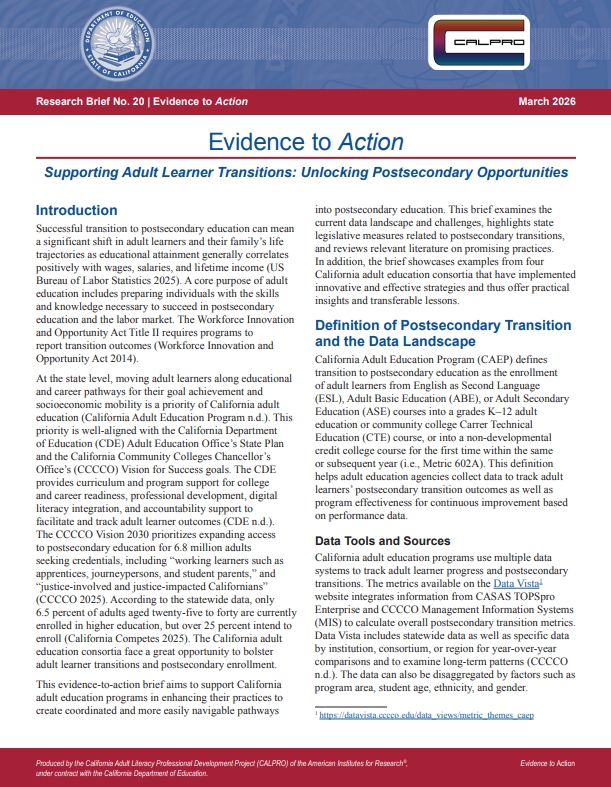
Evidence to Action Brief: Supporting Adult Learner Transitions: Unlocking Postsecondary Opportunities
Successful postsecondary transitions can change the life trajectories of adult learners and their families. Providing effective support for adult learners’ transition to postsecondary education has become one of the critical missions for adult education. This evidence-to-action brief is designed to help California adult education programs strengthen their approaches to building coordinated pathways into posts ...
MARCH 17, 2026
Resource type: Research Publications
AUDIENCE: Administrators , All teacher types , Support Staff
Topic: Post-Secondary Alignment and Pathways
File Type: PDF
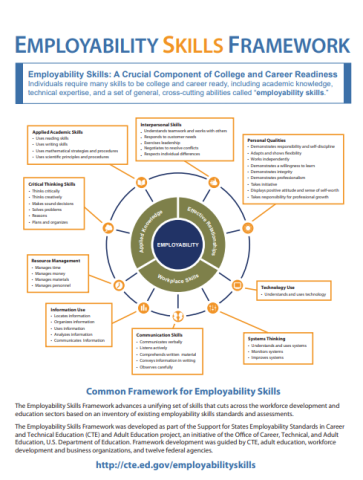
Employability Skills Framework
Employability Skills are general skills that are necessary for success in the labor market at all employment levels and in all sectors. The Workforce Innovation and Opportunity Act of 2014 includes employability skills as a key component of workplace preparation activities for education and training programs. The Employability Skills Framework describes a set of nine key skills, organized in three broad categories: Applied Knowledge, Effective Relationships, and Workplace Skills.
We Train California Administrator Toolkit
The We Train California Administrator Toolkit is a practical resource for adult education administrators, community colleges, and community-based organizations implementing Integrated Education and Training (IET) programs under WIOA Title II. Organized into eight operational sections, the toolkit addresses the essential components of IET implementation, including the concurrent delivery of adult education and literacy activities, workforce preparation activities, and occupational training aligned with in-demand industry sectors and recognized postsecondary credentials. It provides guidance on establishing effective instructional models, including co-teaching and alternating teaching approaches; aligning basic skills instruction with occupational content and competencies; conducting labor market analysis; developing and formalizing workforce and training partnerships; coordinating instructional staff; designing integrated curricula; and meeting programmatic and data reporting requirements. The toolkit serves as an implementation resource to help administrators develop, manage, and continuously improve IET programs that integrate academic instruction with occupational skills training and prepare adult learners for employment and advancement along career pathways.