
The California Department of Education (CDE) is initiating the process of updating the Career Technical Education (CTE) Model Curriculum Standards (MCS) and Framework to bring California into alignment with the Advance CTE National Career Clusters Framework (PDF). This framework serves as the foundation for CTE programs in every state and is used for reporting processes at the national level. This alignment will ensure California's CTE programs stay current, skills-based, and aligned to current workforce needs.

Resources
This page provides a compilation of resources on varied topics relevant to adult educators. Although the number of research studies focusing on adult learners is limited, the items listed in the "Research" category are evidence-based or recognized as "promising practices" by federal and state agencies.
FEATURED RESOURCE
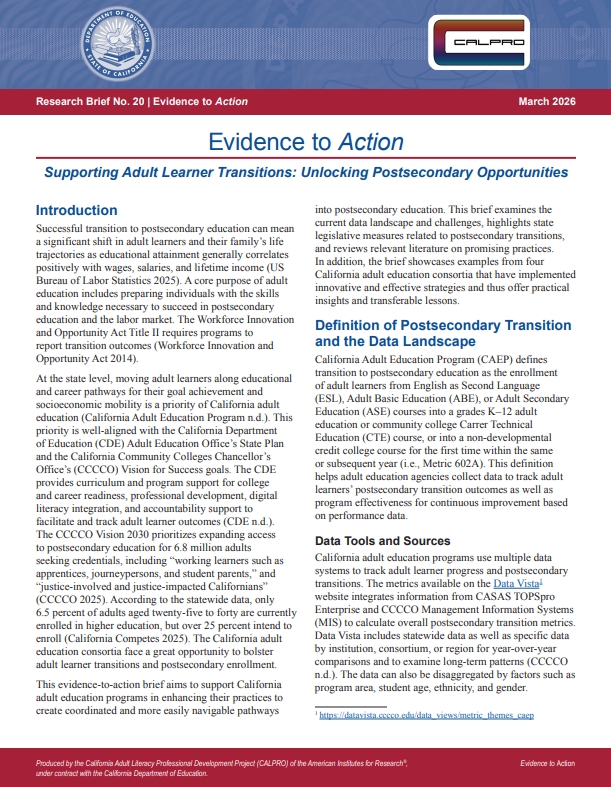
Evidence to Action Brief: Supporting Adult Learner Transitions: Unlocking Postsecondary Opportunities
Successful postsecondary transitions can change the life trajectories of adult learners and their families. Providing effective support for adult learners’ transition to postsecondary education has become one of the critical missions for adult education. This evidence-to-action brief is designed to help California adult education programs strengthen their approaches to building coordinated pathways into posts ...
MARCH 17, 2026
Resource type: Research Publications
AUDIENCE: Administrators , All teacher types , Support Staff
Topic: Post-Secondary Alignment and Pathways
File Type: PDF
147 Results
147 Result
July 15, 2026
 September 23, 2026
 September 23, 2026
 September 23, 2026
 September 23, 2026
 May 02, 2024
The National Career Clusters Framework
Created in 2002 and modernized in 2024, the National Career Clusters Framework has provided a shared structure and language for CTE program design across the United States. Advance CTE serves as the steward of the Framework.
Image
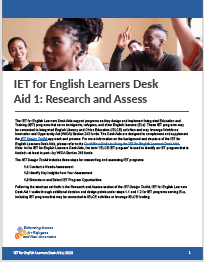
IET for English Learners Desk Aid 1: Research and Assess
The IET for English Learners Desk Aids support programs as they design and implement Integrated Education and Training (IET) programs that serve immigrants, refugees, and other English learners (ELs). These IET programs may be connected to Integrated English Literacy and Civics Education (IELCE) activities and may leverage Workforce Innovation and Opportunity Act (WIOA) Section 243 funds. The Desk Aids are designed to complement and supplement the IET Design Toolkit approach and process. For more information on the background and structure of the IET for English Learners Desk Aids, please refer to the QuickStart Guide to Using the IET for English Learners Desk Aids. Note: In the IET for English Learners Desk Aids, the term “IELCE IET program” is used to identify an IET program that is funded—at least in part—by WIOA Section 243 funds.The IET Design Toolkit includes three steps for researching and assessing IET programs:1.1 Conduct a Needs Assessment1.2 Identify Key Insights from Your Assessment1.3 Brainstorm and Select IET Program OpportunitiesFollowing the structure set forth in the Research and Assess section of the IET Design Toolkit, IET for English Learners Desk Aid 1 walks through additional decision and design points under steps 1.1 and 1.2 for IET programs serving ELs, including IET programs that may be connected to IELCE activities or leverage IELCE funding.
Image
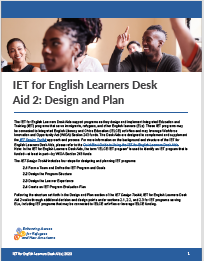
IET for English Learners Desk Aid 2: Design and Plan
The IET for English Learners Desk Aids support programs as they design and implement Integrated Education and Training (IET) programs that serve immigrants, refugees, and other English learners (ELs). These IET programs may be connected to Integrated English Literacy and Civics Education (IELCE) activities and may leverage Workforce Innovation and Opportunity Act (WIOA) Section 243 funds. The Desk Aids are designed to complement and supplement the IET Design Toolkit approach and process. For more information on the background and structure of the IET for English Learners Desk Aids, please refer to the QuickStart Guide to Using the IET for English Learners Desk Aids. Note: In the IET for English Learners Desk Aids, the term “IELCE IET program” is used to identify an IET program that is funded—at least in part—by WIOA Section 243 funds.The IET Design Toolkit includes four steps for designing and planning IET programs:2.1 Form a Team and Define the IET Program and Goals2.2 Design the Program Structure2.3 Design the Learner Experience2.4 Create an IET Program Evaluation PlanFollowing the structure set forth in the Design and Plan section of the IET Design Toolkit, IET for English Learners Desk Aid 2 walks through additional decision and design points under sections 2.1, 2.2, and 2.3 for IET programs serving ELs, including IET programs that may be connected to IELCE activities or leverage IELCE funding.
Image
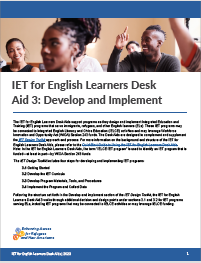
IET for English Learners Desk Aid 3: Develop and Implement
The IET for English Learners Desk Aids support programs as they design and implement Integrated Education and Training (IET) programs that serve immigrants, refugees, and other English learners (ELs). These IET programs may be connected to Integrated English Literacy and Civics Education (IELCE) activities and may leverage Workforce Innovation and Opportunity Act (WIOA) Section 243 funds. The Desk Aids are designed to complement and supplement the IET Design Toolkit approach and process. For more information on the background and structure of the IET for English Learners Desk Aids, please refer to the QuickStart Guide to Using the IET for English Learners Desk Aids. Note: In the IET for English Learners Desk Aids, the term “IELCE IET program” is used to identify an IET program that is funded—at least in part—by WIOA Section 243 funds.The IET Design Toolkit includes four steps for developing and implementing IET programs:3.1 Getting Started3.2 Develop the IET Curricula3.3 Develop Program Materials, Tools, and Procedures3.4 Implement the Program and Collect DataFollowing the structure set forth in the Develop and Implement section of the IET Design Toolkit, the IET for English Learners Desk Aid 3 walks through additional decision and design points under sections 3.1 and 3.2 for IET programs serving ELs, including IET programs that may be connected to IELCE activities or may leverage IELCE funding.
Image
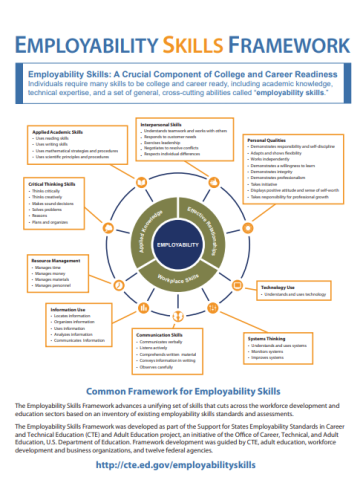
Employability Skills Framework
Employability Skills are general skills that are necessary for success in the labor market at all employment levels and in all sectors. The Workforce Innovation and Opportunity Act of 2014 includes employability skills as a key component of workplace preparation activities for education and training programs. The Employability Skills Framework describes a set of nine key skills, organized in three broad categories: Applied Knowledge, Effective Relationships, and Workplace Skills.
Image
Multilevel ESL Instructors
This workroom supports the professional development of adult education instructors who teach classes of English language learners of varying proficiency levels.