

Career Technical Education (CTE) Model Curriculum Standards - 2013
The Career Technical Education (CTE) Model Curriculum Standards are designed to assist California districts and schools in developing high-quality curriculum and instruction to help ensure that students are career and college ready and to prepare them for future careers. The model standards were created with assistance from more than 300 representatives from business, industry, postsecondary, and secondary education and were reviewed by approximately 1,000 individuals, including members of the general public. The standards are rigorous, evidence-based, relevant, and reasonable in scope. They offer clear guidelines for course content development and expectations for student achievement.

Sample Integrated Syllabus
From the ADVANCE IET initiative, this sample syllabus provides a model example of how to structure and communicate details to learners about the aims, expectations, and core skills components (industry specific, academic, and workplace skills) to be developed within a potential patient care technician course.

Developing an IET Syllabus: Key Elements
From the ADVANCE IET initiative, this checklist is designed to support IET providers in developing a comprehensive, integrated syllabus that can serve as a roadmap for their IET students.
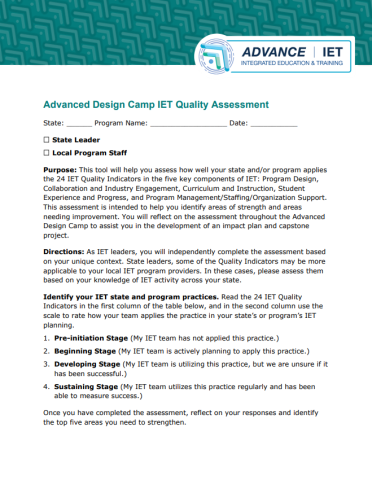
IET Quality Assessment
This tool will help you assess how well your state and/or program applies the 24 IET Quality Indicators in the five key components of IET: Program Design, Collaboration and Industry Engagement, Curriculum and Instruction, Student Experience and Progress, and Program Management/Staffing/Organization Support. This assessment is intended to help you identify areas of strength and areas needing improvement. You will reflect on the assessment throughout the Advanced Design Camp to assist you in the development of an impact plan and capstone project
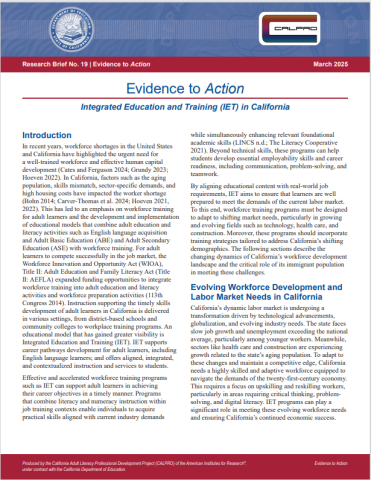
Evidence to Action Brief: Integrated Education and Training (IET) in California
This brief explores the Integrated Education and Training (IET) model in California. It includes the definition, required components, models, and the process and strategies for program development and implementation. The brief also provides the policy guidelines from the California Department of Education and examples from CA adult education programs. It showcases how IET can prepare adult learners for careers in emerging and evolving industries to respond to California's changing demographics and labor market needs.Authors:Sachiko Ozaki Oates; Sudie Whalen; Cory Rayala; Margie Moriarty; Juan Anzaldo; Maximiliano (Max) Rosas; Margo Sterling; Lana Fong; Sara Garcia-Salgado; and Mariann Fedele-McLeod

Planning for Student Success: Barrier Busters and Support Strengtheners
This worksheet is designed to support students in Integrated Education and Training (IET) programs, but it is also suitable for use with all adult education learners during orientation. It helps students identify potential obstacles to educational success and document both personal support systems and wraparound services available through the program or its partners.
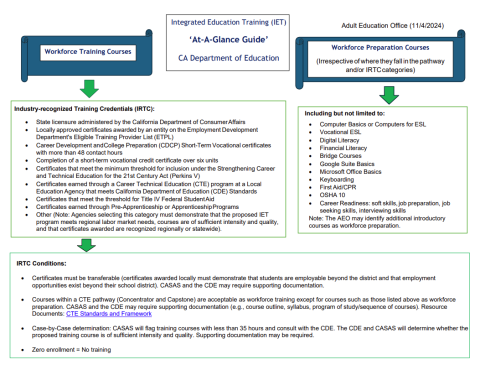
Integrated Education Training (IET) ‘At-A-Glance Guide’ CA Department of Education
The “IET At‑a‑Glance Guide” provides a clear, streamlined overview of how agencies should classify and document Workforce Preparation and Workforce Training within Integrated Education and Training (IET) programs. It outlines which courses qualify as workforce preparation (e.g., digital literacy, vocational ESL, financial literacy, and career readiness skills) and distinguishes these from workforce training options, including CTE pathway courses and industry‑recognized credential programs. This guide serves as a quick reference to help programs correctly categorize offerings and ensure alignment with state guidance for IET implementation.
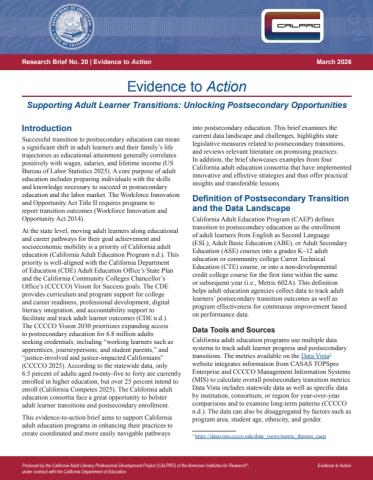
Evidence to Action Brief: Supporting Adult Learner Transitions: Unlocking Postsecondary Opportunities
Successful postsecondary transitions can change the life trajectories of adult learners and their families. Providing effective support for adult learners’ transition to postsecondary education has become one of the critical missions for adult education. This evidence-to-action brief is designed to help California adult education programs strengthen their approaches to building coordinated pathways into postsecondary education. It explores the current data environment and its challenges, outlines relevant state legislation on postsecondary transitions, and synthesizes research on promising practices. The brief also features examples from four California adult education consortia that have adopted innovative, successful strategies, offering practical insights and adaptable lessons for the field.Authors:Sachiko Ozaki Oates (CALPRO/American Institutes for Research)Kathleen Porter (Education to Career Network of North San Diego County)Emma Diaz, Maria E. Lopez, & Pedro F. Gonzalez (Inland Adult Education Consortium)Jenée Crayne (North Santa Clara County Consortium for Adult Education)Pang Vangyi (State Center Adult Education Consortium)
CTE Model Curriculum Standards/Framework Update
The California Department of Education (CDE) is initiating the process of updating the Career Technical Education (CTE) Model Curriculum Standards (MCS) and Framework to bring California into alignment with the Advance CTE National Career Clusters Framework (PDF). This framework serves as the foundation for CTE programs in every state and is used for reporting processes at the national level. This alignment will ensure California's CTE programs stay current, skills-based, and aligned to current workforce needs.