
Management Competencies Self-Assessment
Produced by California Adult Literacy Professional Development Project, 2008; augmented 2018Based on the Management Competencies and Sample Indicators for Improvement of Adult Education Programs (CALPRO, 2025), this self-assessment helps administrators to identify priority areas for targeted professional development, based on their assessment of relevance and current personal capacity across a variety of criteria. In 2018, the self-assessment was augmented with an addendum introduced to identify additional knowledge and skills that program administrators need to possess in order to be effective in today's adult education landscape in California. For each competency and performance indicator, the addendum also suggests professional development resources to assist in building an annual, individualized development plan. Note: This fillable form can be downloaded, saved, and printed (using Adobe Reader or a similar application).
Management Competencies Assessment Instrument
Authors: Renee Sherman, Dionne Dobbins, John Tibbetts, Judith Crocker, and Michael Dlott, American Institutes for Research, March 2002This publication introduces an assessment instrument to help programs implement the management competencies. What follows is a detailed description of the Management Competencies Assessment Instrument (MCAI), including an overview of the various types of evidence that will help verify of the existence of the competencies. To see and use the updated Management Competencies Self-Assessment (2018) visit the following webpage:https://calpro-online.org/resource/management-competencies-self-assessment
Guidelines for Facilitating Discussion Groups Using CALPRO Research Digests, Research Summaries, and Research Bibliographies
Produced by California Adult Literacy Professional Development Project, 2006CALPRO offers these suggested guidelines for initiating and conducting discussion groups using the research digests, summaries, and bibliographies.
Developing Basic Skills Curriculum for an IET: A Guide for the Pathways to Employment Program
Authors: Institute for the Study of Adult Literacy (ISAL), The Pennsylvania State University Central Pennsylvania Workforce Development Corporation (CPWDC), North Central Workforce Development Board (NCWDB), Southern Alleghenies Workforce Development Board (SAWDB), and Pennsylvania College of Technology Produced by The Pathways to Employment initiative funded through the U.S. Department of Labor's 2015 Sector Partnership National Dislocated Worker Grant program, and supported by the Pennsylvania Department of Labor and Industry, February 2017.This guide was prepared by the Pathways to Employment Initiative of the Institute for the Study of Adult Literacy at The Pennsylvania State University, and three Pennsylvania Workforce Development Boards in partnership with local IET training providers (2017, February) to engage stakeholders in curricular collaboration. IET programs in IL, KS, KY, OH, PA, VA, WA and WI are highlighted including descriptions of their course offerings, objectives and partners. This resource focuses on addressing basic skills, rather than occupational skills to help students as they move along their career pathway.The resource is divided into six sections and provides highlighted program snapshots, lesson planning and program design considerations as well as questions and worksheets to foster discussion. Additional resources are also included with direct links to the aforementioned programs. Agencies and their partners can use the guide and ready-to-use tools as they collaborate in the planning and implementation of new or existing IET programs.
Partnering with Employers to Promote Job Advancement for Low-Skill Individuals
Author: Karin Martinson, Abt Associates, Inc., September 2010This paper explores the importance of employer-program partnerships for improving economic outcomes for both low-skill workers and businesses. It identifies the fac¬tors that have hindered the growth of these partnerships as well as promising approaches to building further partnerships.
Workplace Readiness Guide
Authors: Judith Crocker, John Tibbetts, Renee Sherman, and Michael Dlott, American Institutes for Research, May 2002This guide helps agencies assess their ability to design and deliver a workplace education program. The guide is divided into two sections—the instruction and the program administrative characteristics needed for program success.
Program Infrastructure Supports
July 21, 2026
ADVANCE IET: IET Resource Repository
This collection of freely available resources has been compiled to support program development and continuous improvement of quality IET programming, including IET curricular resources.

CALPRO Research Brief: Supporting Student Success Through Social and Emotional Learning
This brief explores the application of the Social Emotional Learning (SEL) principles and related frameworks in adult education. Incorporation of SEL holds great promise in empowering adult learners with the skills needed for personal growth, career success, and active participation in society. It further examines how educators' overall well-being through their own development of SEL skills benefits both the educators and the students. The brief provides practical application ideas and resources for implementation. Examples from two adult education programs in California are also included for inspiration and further exploration of the topic.Authors:Sachiko Ozaki Oates; Kimberly Kendziora; Veronica Tylor; Steven A. Casperite
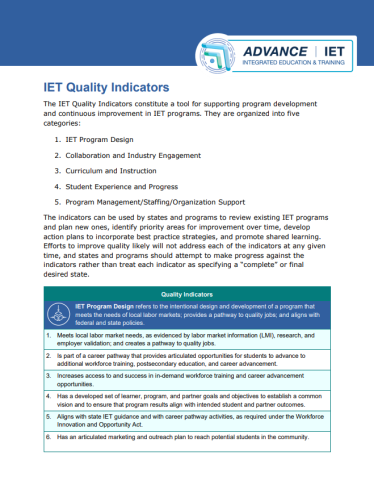
Integrated Education and Training (IET) Quality Indicators
These indicators can be used by states and programs to review existing IET programs and plan new ones, identify priority areas for improvement over time, develop action plans to incorporate best practice strategies, and promote shared learning.