
Supporting Student Transitions to Postsecondary Education & the Workforce
The goal of this CoP is to support adult learners’ postsecondary and workforce transitions by
- building consortia and adult education program staff’s capacity to implement evidence-based practices that facilitate transitions.
- identifying ways to enhance support services, program structures, and local partnerships.
- prioritizing improvement actions and identifying challenges and solutions for implementation.
Supporting Student Transitions to Postsecondary Education & the Workforce
Hosted by the San Joaquin Adult Education ConsortiumThe goal of this CoP is to support adult learners’ postsecondary and workforce transitions bybuilding consortia and adult education program staff’s capacity to implement evidence-based practices that facilitate transitions.identifying ways to enhance support services, program structures, and local partnerships. prioritizing improvement actions and identifying challenges and solutions for implementation.
Supporting Student Transitions to Postsecondary Education & the Workforce
Hosted by the Ventura County Adult Education Consortium The goal of this CoP is to support adult learners’ postsecondary and workforce transitions bybuilding consortia and adult education program staff’s capacity to implement evidence-based practices that facilitate transitions.identifying ways to enhance support services, program structures, and local partnerships. prioritizing improvement actions and identifying challenges and solutions for implementation.Location: Oxnard Adult School at 1800 Solar Drive, OxnardTime: 1:00pm - 3:00pmRegistration Information:This tailored regional CoP is designed for the members of the Ventura County Adult Education Consortium. There is no registration fee to participate; CALPRO professional development opportunities are available to all California Adult Education Program (CAEP) agencies and employees.
Motivating Learners and Implementing English Language Proficiency (ELP) Standards
Hosted by Turlock Adult SchoolIt takes persistence as well as effective instruction for adult learners to significantly increase their skills to achieve their goals, whether it is in their community, workplace, or in postsecondary education. Adult educators can support learners to persist and efficiently gain relevant skills by implementing standard-based instruction and evidence-based motivation strategies. This tailored community of practice (CoP) provides an overview of the motivation strategies and introduces the English Language Proficiency (ELP) Standards. The CoP will provide an opportunity for participants to plan classroom activities that incorporate the standards and motivation strategies. Location: Turlock Adult SchoolDate: Tuesday, April 15th, 2025Time: 3:30pm - 6:30pmRegistration Information:This tailored regional CoP is designed for the Turlock Adult School staff and teachers.There is no registration fee to participate; CALPRO professional development opportunities are available to all California Adult Education Program (CAEP) agencies and employees.
Research Forum: Strategies for Effective Instruction: Fundamentals of Adult Education
Research Forum Webinar on Fundamentals of Adult Education Instruction
Facilitator: Sachiko Oates
CALPRO Research Forum: Formative Assessment for Data-Informed Differentiated Instruction
This one-hour webinar explores how formative assessment can enhance teaching and learning to support adult learners' persistence and goal achievement. The webinar will address common misconceptions about formative assessment, such as the belief that it’s too time-consuming or only useful for teachers. Through examining real-life examples, participants will learn strategies for collecting and analyzing learner data to inform differentiated instruction. The session will include practical examples, tools for implementation, and opportunities for reflection and discussion.
Presenter: DeAnne Berryhill
Supporting Adult Learner Transitions: Unlocking Postsecondary Opportunities
Panel DiscussionSuccessful postsecondary transitions can change the life trajectories of adult learners and their families. According to the statewide data, only 6.5% of adults 25-40 are currently enrolled in higher education while over 25% intend to enroll. Providing effective support for adult learners’ transition to postsecondary education has become one of the critical missions for adult education. This research forum webinar will feature four California Adult Education Consortia that are implementing innovative, learner‑centered approaches to improve transitions into postsecondary programs. Panelists will share practical insights, lessons learned, and replicable models that other regions can adapt.Featured Implementation Examples:Education to Career Network of North San Diego County: Sustainable Structures and Collaborative Culture Inland Adult Education Consortium: Successful Transition CounselingNorth Santa Clara County Consortium for Adult Education: Dual Enrollment for All CAEP StudentsState Center Adult Education Consortium: Student Ambassador Model
Research Forum: Designing for All: Universal Design for Learning for Adults with Learning Disabilities
This research forum webinar introduces the Universal Design for Learning (UDL) framework as well as the accommodations and modifications that support learning, self-determination, and success for adult learners, including learners with learning disabilities. We will discuss the challenges adult education professionals face while supporting adults with learning disabilities and share strategies and tools that work.
Date: 2/17/2026
Presenter: Marie Doerner
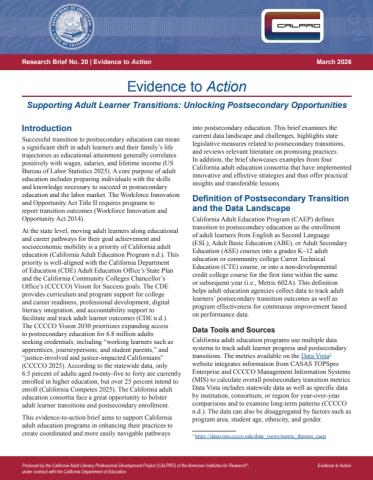
Evidence to Action Brief: Supporting Adult Learner Transitions: Unlocking Postsecondary Opportunities
Successful postsecondary transitions can change the life trajectories of adult learners and their families. Providing effective support for adult learners’ transition to postsecondary education has become one of the critical missions for adult education. This evidence-to-action brief is designed to help California adult education programs strengthen their approaches to building coordinated pathways into postsecondary education. It explores the current data environment and its challenges, outlines relevant state legislation on postsecondary transitions, and synthesizes research on promising practices. The brief also features examples from four California adult education consortia that have adopted innovative, successful strategies, offering practical insights and adaptable lessons for the field.Authors:Sachiko Ozaki Oates (CALPRO/American Institutes for Research)Kathleen Porter (Education to Career Network of North San Diego County)Emma Diaz, Maria E. Lopez, & Pedro F. Gonzalez (Inland Adult Education Consortium)Jenée Crayne (North Santa Clara County Consortium for Adult Education)Pang Vangyi (State Center Adult Education Consortium)
Supporting Adult Learner Transitions to Postsecondary Education & the Workforce
Hosted by the Central Valley Mother Lode Regional Consortium (Designed for member community colleges and adult education consortia in the Central Valley)The goal of this CoP is to support adult learners’ postsecondary and workforce transitions bybuilding adult education consortia and program staff’s capacity to implement evidence-based practices that facilitate learner transitions.identifying ways to enhance support services, program structures, and regional partnerships. prioritizing improvement actions and identifying challenges and solutions for implementation.Registration Information:This tailored regional CoP is designed for the members of the following adult education consortia: Kern Adult Education ConsortiumMerced Gateway Adult Education NetworkDelta Sierra Adult Education AllianceSequoias Adult Education ConsortiumState Center Adult Education ConsortiumWest Hills Adult Education ConsortiumWest Kern Adult Education ConsortiumStanislaus Mother Lode (Yosemite) Adult Education ConsortiumThere is no registration fee to participate.