
Application Deadline: Integrated Education and Training (IET) Implementation Clinic, Spring 2026
Apply now for CALPRO's Spring 2026 Integrated Education and Training (IET) Implementation Clinic. IET Clinic is designed for program staff who seek more support in meeting the IET implementation challenges they face and are interested in learning from other IET practitioners. Clinic overview:Each participating agency team includes three members: an IET program administrator, an English as a Second Language (ESL) instructor, and a Career and Technical Education (CTE) instructor.The innovative format of this fully online clinic includes the following elements:Two day-long virtual training sessionsThree live, interactive webinars (75–90 minutes each), with topics tailored to the needs and interests of the participating teamsOngoing discussions in an online community of practice Team capstone projectCoaching (following completion of the clinic)Link to application and additional details:CALPRO Application: Online Integrated Education and Training (IET) Implementation Clinic, Spring 2026To apply, each member of the agency team must complete the application by February 6, 2026, at 5:00 p.m. Notifications of acceptance will occur by February 13, 2026. [Please note that each member of your three-person agency team is required to submit an application.]Clinic topics:Topics will be tailored to the needs of the participating practitioners and identified through the application process. Sample topics includeStarting Strong: Developing the Team-Teaching PartnershipBuilding an Integrated SyllabusPromising Intake & Onboarding Strategies for IETand moreEligibility to apply:Membership and participation are free of charge and open to all California adult education funded programs. Preference will be given to IET program team staff working in an Integrated EL Civics IET program that is funded through Section 243 of the Workforce Innovation and Opportunity Act, Title II: Adult Education and Family Literacy Act (WIOA, Title II: AEFLA) grant. Not sure if you’re eligible? Let CALPRO help—email calpro@air.org or call 1-916-286-8803.Key dates:February 6, 2026 — Applications due; each member of your team must submit a separate application; access the application hereFebruary 25, 2026, 1–2:15 p.m. — Webinar 1: Kickoff and orientation sessionMarch 20, 2026, 9 a.m.–2 p.m. — Virtual Session 1April 16, 2026, 1–2:30 p.m. — Webinar 2April 29, 2026, 1–2:15 p.m. — Webinar 3June 5, 2026, 9 a.m.–2 p.m. — Virtual Session 2Contact information:Contact CALPRO at calpro@air.org or (916) 286-8803.
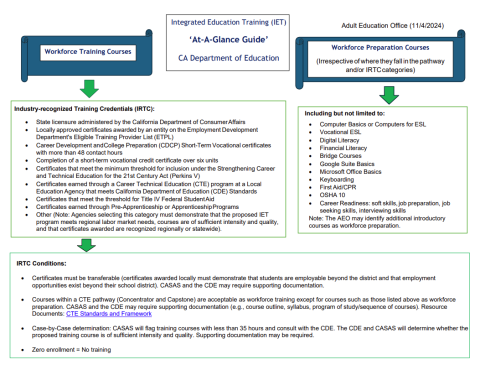
Integrated Education Training (IET) ‘At-A-Glance Guide’ CA Department of Education
The “IET At‑a‑Glance Guide” provides a clear, streamlined overview of how agencies should classify and document Workforce Preparation and Workforce Training within Integrated Education and Training (IET) programs. It outlines which courses qualify as workforce preparation (e.g., digital literacy, vocational ESL, financial literacy, and career readiness skills) and distinguishes these from workforce training options, including CTE pathway courses and industry‑recognized credential programs. This guide serves as a quick reference to help programs correctly categorize offerings and ensure alignment with state guidance for IET implementation.
Aligning CTE Standards to the CCRS and ELPS
This video provides adult educators, curriculum developers, and program leaders with practical guidance for aligning and integrating three essential educational frameworks: the Career and Technical Education (CTE) Model Curriculum Standards, the College and Career Readiness Standards (CCRS) for Adult Education, and the English Language Proficiency Standards (ELPS) for Adult Education. Through examples and instructional strategies, viewers will learn how to connect career-focused content with academic readiness and language development goals to create more cohesive and effective learning experiences for adult learners. The video supports the design of integrated instruction that prepares students for workforce success, postsecondary opportunities, and continued skill development.
Teaching Critical Thinking (Workshop Series, Registration Closed)
Critical thinking is an essential skill found in both the College and Career Readiness Standards and the English Language Proficiency Standards for Adult Education. Critical thinking skills are needed in every facet of our lives, and in particular as we are inundated with more information from a variety of dependable and undependable sources. This online workshop series will prepare you to include a variety of critical thinking strategies in your adult education classes. It is presented in three 1.5 hour webinars. Registration information*: Registration for these sessions is now closed. Scheduled session dates and times are as follows: Session 1: Tuesday, April 29, 2025 | 2:30 PM – 4:00 PMSession 2: Tuesday, May 6, 2025 | 2:30 PM – 4:00 PMSession 3: Tuesday, May 13, 2025 | 2:30 PM – 4:00 PM*Please note: Registering for Session 1 automatically registers you for Session 2 and 3. Certificate of Completion will reflect hours attended.
CALPRO Training-of-Trainers Institute
WHAT AND WHERE?
CALPRO annually conducts the Training-of-Trainers (ToT) Institute for the new community of practice (CoP) at the CALPRO office in Sacramento. The purposes of the ToT Institute are:
- To develop a group of certified trainers to facilitate presentations of CALPRO professional learning modules
- To build professional development capacity and leadership in California adult education.
WHAT IS CALPRO’S COMMUNITIES OF PRACTICE INITIATIVE AND HOW DOES IT IMPACT THE ToT?
Communities of Practice are formed by groups of professionals who engage in a process of collective learning in a shared domain (adapted from Wenger, 2002). CALPRO’s Communities of Practice (CoP) Initiative aims to increase the field’s focus on supported implementation of skills, strategies and action plans that participants develop in CALPRO trainings and institutes.
For each CoP training, an online community is established. Participants meet each other and begin learning together online; they continue to build community, knowledge and skills in the face-to-face training sessions; and they have the option of continuing to support each other’s efforts to apply new learning after the conclusion of the face-to-face sessions. CALPRO CoP trainers facilitate the entire process, including online and face-to-face sessions.
WHO SHOULD ATTEND?
The ToT is open to applicants from all California Adult Education Program (CAEP) funded agencies (see page 2). The ToT is for individuals who will commit to following up on the ToT by presenting the module for their agency, for their region, or for CALPRO at least once within a year of the ToT.
WHAT ARE EXPECTATIONS OF PARTICIPANTS?
Participants will be expected to complete pre-Institute assignments online. Participants are expected to attend the entire ToT Institute – no exceptions – and demonstrate facilitation skills in practice sessions during the ToT. After completing the ToT, participants are expected to be available to facilitate training at their agency, at other agencies, or at CDE- or CALPRO-organized events within a year of the ToT. Trainers will receive an honorarium for training conducted.
WHAT’S IN IT FOR MY AGENCY?
Your agency will have trained facilitator(s) on your staff who can serve as an in-house content specialist. Your agency will have increased capacity to provide high quality professional learning opportunities.
WHICH AGENCIES ARE ELIGIBLE TO PARTICIPATE?
Employees of all California Adult Education Program (CAEP) funded agencies are eligible to apply. For more information, contact coordinator Marcela Movit.
Teacher Collaboration Institute: Lesson Study Processes and Tools
This training is not just a learning opportunity, but a chance to empower adult education teachers with the skills and practices necessary for effective team collaboration through the Lesson Study Process. The goal is for teachers to collaboratively evaluate and enhance lessons using strategies such as lesson study, lesson charrettes, and peer observation. By engaging in these collaborative practices, teachers will be able to implement their learning directly into their teaching practices, fostering continuous improvement and the development of effective instructional strategies.CALPRO pairs each team with an implementation coach, providing a safety net of support. Each Coaching and Facilitation Team member has extensive experience in collaborative team building and planning. The coaches will be there to assist teams during their six months in the Teacher Collaboration Institute.ObjectivesEffectively implement collaborative practices within a team environment.Evidence: Documented instances of lesson charrettes, peer observations, and completed lesson study cycles. Feedback from participants on the efficacy of collaboration. Demonstrate improvement in their instructional strategies based on collaborative feedback and analysis.Evidence: Pre- and post-assessment of teacher instructional practices, changes in student engagement and learning outcomes, and qualitative feedback from teachers about their instructional changes. Sustain ongoing professional development and collaborative practices.Evidence: Creation of sustainability plans by each team collaboration, reports on subsequent year activities planned or initiated, and establishment of mentorship roles among experienced teachers.ExpectationsActive Participation: Attend all training sessions, regularly log in to Moodle, participate in discussions, and complete assignments and activities (35 total training hours).Reflection and Application: Reflecting on learning and applying concepts to real-world teaching scenarios. The goal is to improve your practice and student learning at your school.Collaborative Engagement: Your engagement with peers, sharing of insights, and providing constructive feedback is what makes our community strong. It's through this collaboration that we all grow and learn.Feedback to CALPRO: Submit evaluative feedback on your CALPRO Teacher Collaboration Institute experience with recommendations to CALPRO for refinement.Coaching and Support: Engage with your implementation coach at least once a month during the institute. For more information, contact coordinator Sudie Whalen.
Application Deadline: Teacher Collaboration Institute: Lesson Study Processes and Tools
CALPRO and the California Department of Education are pleased to announce the opening of the application to the new Teacher Collaboration Institute: Lesson Study Processes and Tools! This training is not just a learning opportunity, but a chance to empower adult education teachers with the skills and practices necessary for effective team collaboration through the Lesson Study Process. The goal is for teachers to collaboratively evaluate and enhance lessons using strategies such as lesson study, lesson charrettes, and peer observation. By engaging in these collaborative practices, teachers will be able to implement their learning directly into their teaching practices, fostering continuous improvement and the development of effective instructional strategies.CALPRO pairs each team with an implementation coach, providing a safety net of support. Each Coaching and Facilitation Team member has extensive experience in collaborative team building and planning. The coaches will be there to assist teams during their six months in the Teacher Collaboration Institute. Please note this is not training on co-teaching, although co-teachers are welcome to apply. To apply, each member of the agency team must complete the application by October 14, 2024. Notifications of acceptance will occur by October 17, 2024. (Please note that each member of your teaching team is required to submit an application). Click here to access the application.ObjectivesEffectively implement collaborative practices within a team environment.Evidence: Documented instances of lesson charrettes, peer observations, and completed lesson study cycles. Feedback from participants on the efficacy of collaboration. Demonstrate improvement in their instructional strategies based on collaborative feedback and analysis.Evidence: Pre- and post-assessment of teacher instructional practices, changes in student engagement and learning outcomes, and qualitative feedback from teachers about their instructional changes. Sustain ongoing professional development and collaborative practices.Evidence: Creation of sustainability plans by each team collaboration, reports on subsequent year activities planned or initiated, and establishment of mentorship roles among experienced teachers.ExpectationsActive Participation: Attend all training sessions, regularly log in to Moodle, participate in discussions, and complete assignments and activities (35 total training hours).Reflection and Application: Reflecting on learning and applying concepts to real-world teaching scenarios. The goal is to improve your practice and student learning at your school.Collaborative Engagement: Your engagement with peers, sharing of insights, and providing constructive feedback is what makes our community strong. It's through this collaboration that we all grow and learn.Feedback to CALPRO: Submit evaluative feedback on your CALPRO Teacher Collaboration Institute experience with recommendations to CALPRO for refinement.Coaching and Support: Engage with your implementation coach at least once a month during the institute.Registration Information :This Institute is open to all WIOA: Title II, AEFLA, and California Adult Education Program-funded agencies. Teams of at least two teachers with administrator approval are required to participate in the Institute. Not sure if you’re eligible? Let CALPRO help: email calpro@air.org or call 1-916-286-8803.Contact Information :Contact CALPRO at calpro@air.org or (916)286-8803
Civic Engagement through Democratic Literacy
Hosted by Los Angeles City CollegeCivic Education and Democratic Literacy play a pivotal role in empowering students to become engaged and informed citizens. Individuals equipped with this knowledge understand political and civic systems, allowing them to navigate these systems effectively and contribute meaningfully to the improvement of their communities. The goal of this CoP is to enhance the capacity of adult educators and programs to provide instruction that amplifies student perspective and voice, builds civic engagement, and dives deep into participatory approaches to democratic processes for adults including those who are developing literacy and language skills.Date: 3/07/2025Time: 9 a.m.- 12 p.m.Location: LACC Room: TBDRegistration Information:This tailored regional CoP is hosted by Los Angeles City College. Participants from neighboring districts or regions may be admitted on a space-available basis. There is no registration fee to participate; CALPRO professional development opportunities are available to all California Adult Education Program (CAEP) agencies and employees.
Communities of Practice Pilot: Fundamentals of Adult Education Instruction Session 1
Session 1 at Fremont Adult and Continuing EducationWhat are “Communities of Practice”?Communities of Practice are groups of people who share a concern or a passion for something they do and strive to learn how to do it better as they interact regularly.1 To provide opportunities for California adult educators to interact regularly and to engage in sustained professional development, CALPRO is offering professional development in a Community of Practice format that includes online interaction along with two face-to-face sessions.What is a pilot?This Community of Practice is complete and ready for participants, but before offering it statewide, we are field-testing the content, design, and the online activities as a pilot. Throughout the pilot, participants will be asked for feedback. This feedback will be used to improve the delivery of future trainings.What are the benefits of participating in this CoP Pilot?More in-depth engagement with training content;Opportunity for “early adoption” of best practices;Opportunity to interact with fellow educators and the trained facilitator synchronously and asynchronously to share practical experiences and problem solve;Collegial support for thinking about program and curriculum changes;Contribution to the development of an enriched statewide professional development experience for adult educators in California.